CAD Security
DLP
HaloCAD
Defense: DLP alone can’t protect your IP. Here’s what can.
DLP and Secude solutions work alongside each other to protect your IP data from generation to storage and in transit. Here’s how.
February 23, 2026
.png)
DLP and Secude solutions work alongside each other to protect your IP data from generation to storage and in transit. Here’s how.
Submarine motors. Aircraft engines. Spatial systems. Command platforms.
No matter the product, CAD software underpins the modern Defense production chain and contains Defense contractors’ most confidential intellectual property (IP). But most of the Defense industry relies on Data Loss Prevention (DLP) tools to protect their CAD data, which leaves security gaps for cyberattackers to exploit.
Here’s how Secude works with your existing DLP tools to close your security gaps and protect your IP.
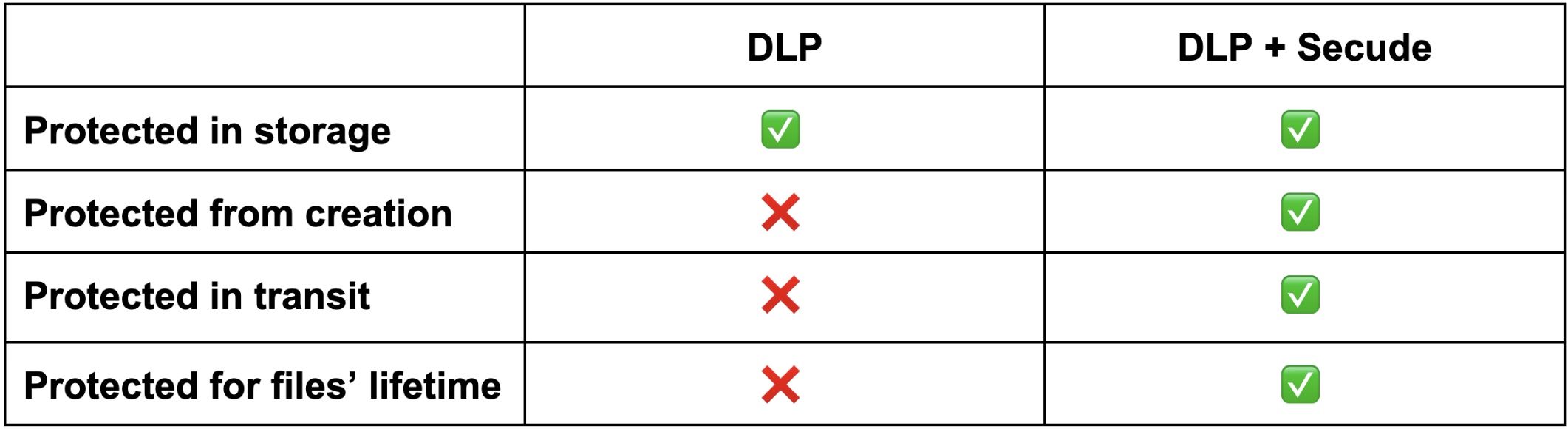
Your CAD files are your priceless crown jewels, containing your trade secrets (and national security interests). DLP security acts like a bank vault, locking down these jewels and protecting them from internal and external threats. But DLP security does not protect these jewels when they’re first created or when they’re travelling to and from the bank vault.
With DLP, your priceless CAD files are:
Working alongside your existing DLP solutions, Secude’s file-level security closes these CAD file security gaps.
With Secude & DLP, your CAD files are:
DLP + Secude = ultimate CAD file protection
IP leakage is catastrophic for your company, ruining your reputation, exposing your secrets, and harming your chances of winning DoD contracts. But losing IP that is Controlled Unclassified Information (CUI) is also potentially detrimental for national security.
With Secude working alongside your existing DLP tools, your CAD files are always protected from external and insider threats as unauthorized personnel cannot access your CAD files even if they get hold of them. As a result, you don’t have to worry about sharing sensitive files with third-party contractors or an engineer downloading CAD files onto a USB stick and moving to a competitor.
Defense industry compliance standards require CAD file security that secures confidential data and tracks who has access to it. For example, if your technical engineering drawings are considered CUI, your CAD file security needs to satisfy over 100 NIST controls - including proof of authorized access controls and audit logs - for CMMC compliance.
With your DLP tools & Secude working together, you not only secure CAD files from creation, but also track where files travel for their lifetime, who accesses these files and where they are stored, helping you showcase top-of-the-range data protection to regulators and the DoD.
Cyber attackers exploit gaps in digital supply chains to access your sensitive IP. By targeting less-security focused third-parties (i.e. a custom parts supplier or software support team), attackers can infiltrate your cloud-based PLM or steal CAD files directly.
With Secude working alongside DLP, your CAD files have lifetime sensitive labels that prevent unauthorized access even if there is a data breach. You can also monitor usage and revoke third-party access at any time (i.e. after an NDA expires or project finishes).
Example: Microsoft Purview Information Protection (MPIP)
MPIP helps Defense companies using Microsoft 365 to protect and manage data across different environments, but its sensitivity labels only encrypt and track native MS Office files. Secude’s HaloCAD extends MPIP protection to all major CAD file formats (i.e. Autodesk, Siemens, PTC, and Dassault Systemes etc), embedding lifelong encryption and data governance into CAD files from creation.
Check out how an aerospace contractor uses Microsoft and Secude to protect, track and control access to CAD files that are CUI and simplify CMMC compliance.
Secude and DLP tools serve different parts of the security journey. DLP tools keep your CAD files secure after data is stored. Secude keeps your CAD files secure before data is stored and when data travels.
Together, they protect your CAD files (and the IP contained within them) for its lifetime.
For more information, check out how Secude’s solutions work for Defense.
.png)
.png)
.png)
.png)